
An AI pilot can produce an impressive demonstration and still struggle as a daily business process.
A pilot usually tests whether a tool can perform a task under selected conditions. Daily operations require something broader. The process must work repeatedly, with changing inputs, different users, time pressure, exceptions, quality controls and clear responsibility.
Operational design problems can contribute to an AI pilot failing in daily use. The model may be capable, but the workflow may be incomplete, the data inconsistent, final responsibility unclear or the expected value insufficiently defined. These are practical considerations, not a universal explanation for every pilot outcome.
This distinction matters for small businesses, marketing teams, operations teams and CRM professionals. A useful pilot is not merely a successful demonstration. It is a structured test of whether an AI-supported process can deliver acceptable value under realistic operating conditions.
The recommendations in this article are practical editorial guidance. The cited NIST AI Risk Management Framework provides related guidance on responsibilities, data suitability, human oversight, deployment-like measurement, production monitoring and response planning. It does not establish that these factors cause a particular failure rate or explain every AI pilot outcome.[1]
A pilot is not the same as an operational system
A pilot often has characteristics that make success easier:
- A small number of carefully selected examples
- A motivated person who understands the tool
- Extra time to check and correct outputs
- Clean or manually prepared data
- A narrow use case
- Few exceptions
- Close attention from the person running the test
Daily operations may instead involve incomplete information, multiple contributors, deadlines, unusual cases, changing products or policies, manual handoffs and uncertainty about who is accountable for mistakes.
NIST recommends assessing AI performance in conditions resembling deployment and monitoring behavior in production.[1] In practical terms, a pilot can answer, “Can this work in a controlled example?” without answering:
- Who will use it and at what point in the process?
- What happens when the output is wrong or incomplete?
- Who reviews the result?
- How will the team know whether it is creating value?
- What happens when the tool, data or business rules change?
If these questions are not addressed, the pilot may create enthusiasm without creating a dependable process.
Operational issues to examine before expanding an AI pilot
1. The pilot starts with a tool instead of a business problem
A team may begin with a new AI application and then search for something interesting to do with it. This can produce a demonstration, but not necessarily a valuable workflow.
Instead of asking, “How can we use an AI assistant to generate more content?” a stronger starting point is: “Which part of our content process is slow, repetitive or difficult to scale, and what quality level must be maintained?”
The second question may reveal that the real issue is gathering source material, unclear approvals, incomplete briefs or adapting an approved message across channels. AI may help with one part of that process, but the tool is not the process itself.
2. The pilot uses ideal inputs
A demonstration often uses information that has already been cleaned and organized. A CRM-related pilot might work with complete spreadsheet records, while daily use involves missing fields, inconsistent names, old information, duplicates, ambiguous notes or conflicting sources.
The process therefore needs an explicit input policy. Define required fields, acceptable formats, handling for missing information, conditions that should stop the workflow or request clarification, and responsibility for recurring data problems. NIST’s guidance on data selection, suitability and representativeness is relevant here, particularly MAP 2.3.[1]
3. No one owns the final decision
An AI system may generate a recommendation, summary, classification or draft without the team agreeing who accepts, changes or rejects it. People may assume someone else checked the result, approve without understanding limitations or avoid the workflow because responsibility feels unclear.
Define what the reviewer checks and who makes the final decision. Also specify which errors require correction, which cases must be escalated and where the decision is recorded. NIST’s guidance on documented responsibilities and communication about AI risks is relevant to this design, including GOVERN 2.1.[1]
Oversight is a practical control, not a guarantee of correct outputs. A reviewer still needs sufficient time, context and authority to identify and address problems.
4. The pilot measures output quality but not business value
Asking whether an AI-generated output “looks good” is a useful starting point, but it is not enough to justify an operational workflow. Depending on the use case, evaluation may include time per item, major-edit rate, completion within the target time, rework, adoption, review completion, operating cost and a relevant business outcome.
The complete review and correction effort should be included. Whether review effort offsets time saved is an evaluation criterion, not an assumption. NIST’s measurement guidance, including MEASURE 2.3 and MEASURE 2.4, supports evaluating performance and its context rather than relying on a single output-quality impression.[1]
5. The workflow creates more work than it removes
Generating a draft may be fast, but users may then need to verify claims, rewrite the tone, check formatting, compare the output with source documents, remove confidential information or resolve inconsistencies.
Treat the possibility that review and correction could outweigh the original effort as a test condition. Compare the old and AI-supported workflows from intake through final approval, rather than measuring only the time spent generating the first output.
6. Exceptions were excluded from the design
A process that handles only the normal case may not be ready for daily operations. Exceptions can include an uncategorized customer request, contradictory campaign instructions, sensitive information, outdated source material, an output below the quality threshold or a decision outside the team’s authority.
Define whether the workflow should stop, request more information, route the case to a named specialist, continue with a warning, use a manual process or record the exception for improvement. The appropriate control depends on risk, sensitivity, volume and the consequences of an error. NIST’s guidance on monitoring, overrides, incident response and recovery is relevant here, including MANAGE 4.1.[1]
A workflow does not need to handle every case automatically. It does need to make uncertain cases visible and manageable.
7. The process depends on one enthusiastic person
A pilot may depend heavily on one person who understands the tool, knows the business context and compensates for weaknesses manually. That person may clean inputs, rewrite prompts, notice unreliable results, remember undocumented workarounds and explain the process to others.
If the workflow is expanded, document its purpose, required inputs, standard steps, review criteria, escalation rules, known limitations and examples of acceptable and unacceptable outputs. The documentation needs to be usable by the people expected to perform the work.
8. The workflow is disconnected from existing systems
An AI tool may work well in isolation but create friction when users copy information between applications. Manual transfer can lead to wrong records, lost context, stale source systems, duplicates and delayed next steps.
The appropriate level of integration depends on risk, sensitivity, volume, user needs and integration requirements. Ask where the request begins, where the output goes, which system is the source of truth, who updates the record, how completion is confirmed and what happens if the transfer fails.
If these answers are unclear, the pilot is testing a tool in isolation rather than testing the operational process.
9. The team ignores change over time
Offers, customer questions, internal policies and source information change. An AI workflow may continue producing plausible outputs after its instructions or reference material become outdated.
Define who reviews instructions and source material, how often the workflow is checked, what events trigger an early review, how feedback and errors are recorded, and who approves changes. NIST recommends monitoring system behavior in production and planning how issues will be managed.[1]
Practical example: an AI content workflow
The following is a hypothetical illustration, not a documented DaniLabb customer result or a research finding.
Imagine a small marketing team testing an AI workflow to turn a long product briefing into a draft email, social post and short article outline.
What the pilot tests
The team provides a clean briefing with the target audience, a clear offer, approved product information, a defined tone and a call to action. The AI produces drafts quickly, the team makes a few edits and the concept looks promising.
What might happen in daily operations
New briefs arrive from different people. Some omit the target audience. Others contain unapproved claims. A product detail changes, but the shared reference document is not updated. The reviewer is unavailable on a deadline.
The workflow now needs a standard brief, required fields, a source of truth for approved claims, a review checklist, a named approver, a process for missing or conflicting information and a record of the source-material version used.
This illustration does not establish that the workflow failed or identify a documented cause. It shows how operating conditions could create additional requirements even when an initial writing demonstration is promising.
How to design a pilot that can move toward operations
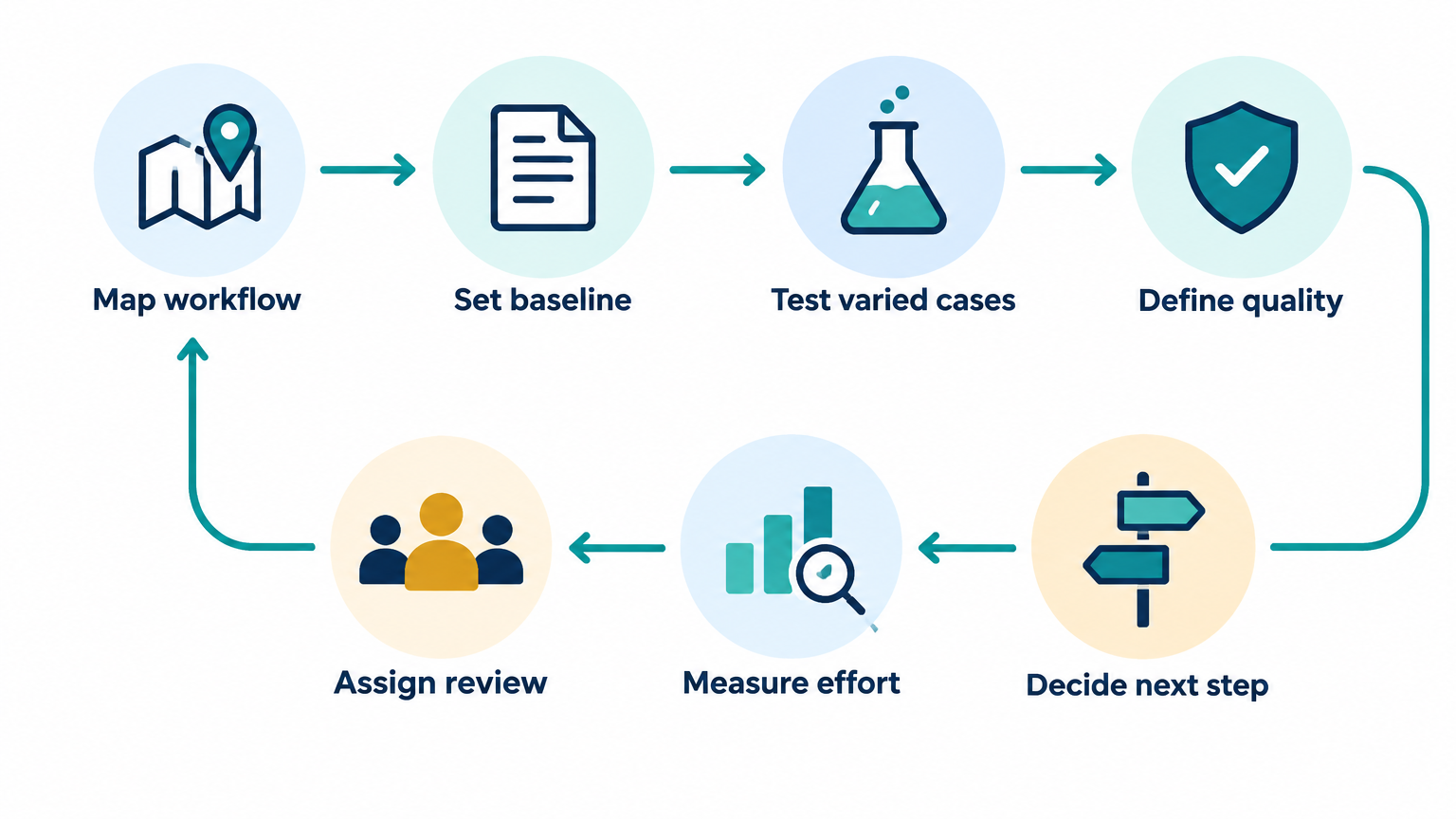
- Map the process before selecting the tool: identify the trigger, inputs, decisions, output, reviewer, storage location and next step.
- Establish a baseline for time, people involved, rework, quality problems and volume.
- Test normal, incomplete, ambiguous, outdated, conflicting, rejectable and escalation cases.
- Define quality standards before reviewing results.
- Assign review and escalation responsibilities appropriate to the workflow’s risk.
- Measure total effort from request through approved result, not generation time alone.
- Observe intended users operating the workflow under ordinary conditions.
- Decide whether to continue, make specific changes, narrow the use case or stop.
A simple operational readiness checklist
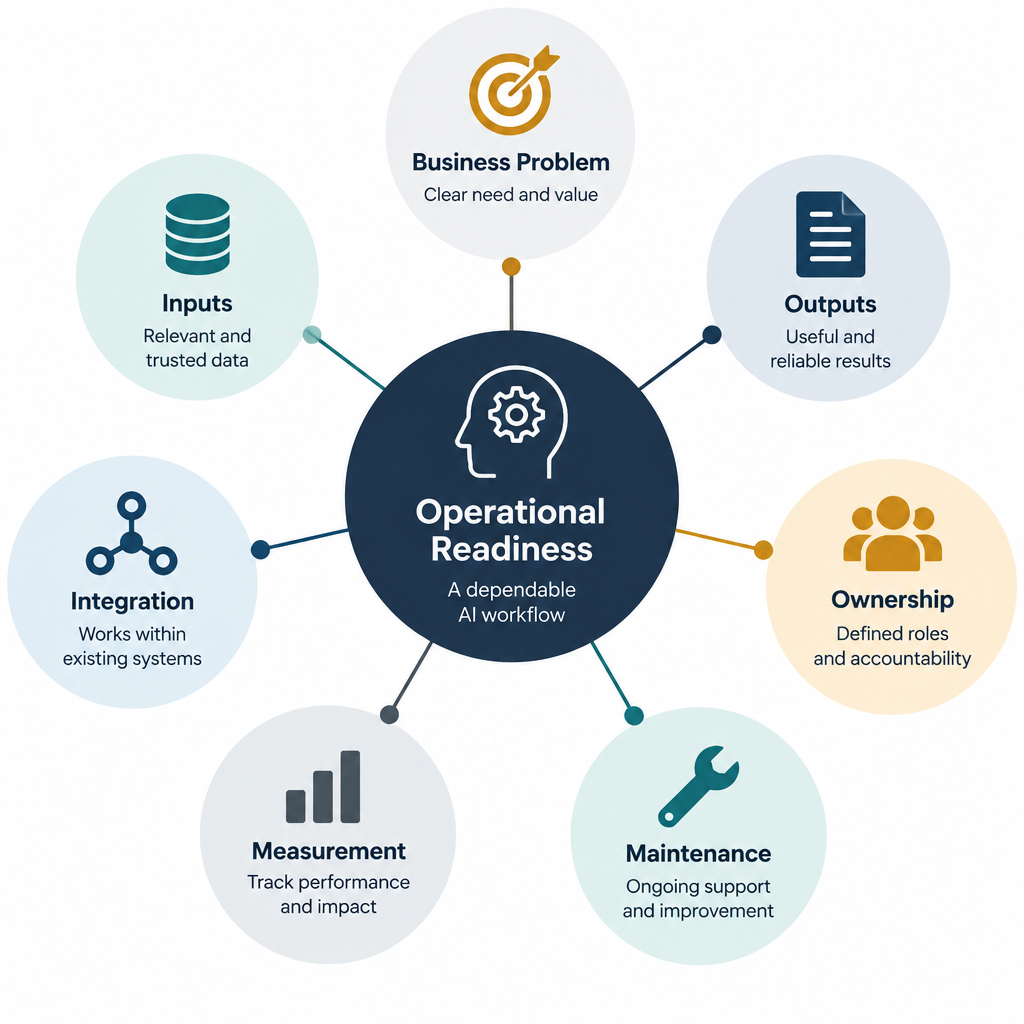
Before moving an AI pilot into regular use, ask:
Business problem
- Is the problem clearly defined?
- Is the AI-supported step connected to a meaningful business objective?
- Is there a baseline for comparison?
Inputs
- Are required inputs defined?
- Can the workflow detect missing or conflicting information?
- Is sensitive information handled appropriately?
Outputs
- What does an acceptable output look like?
- Which errors are unacceptable?
- Can users correct the output efficiently?
Ownership
- Who owns the process?
- Who reviews the output?
- Who handles exceptions?
- Who approves changes to the workflow?
Integration
- Where does the workflow begin and end?
- Which system is the source of truth?
- Are handoffs documented?
Measurement
- What will be measured?
- How will quality, effort and value be compared with the baseline?
- What result would justify continuing?
Maintenance
- How will changes in source information be managed?
- How will errors and feedback be recorded?
- When will the workflow be reviewed?
If several answers are unclear, the pilot may need more process design before it needs more technology.
What small businesses should do first
Small businesses can start with one narrow, repeatable workflow that has a visible business problem, manageable risk, a clear owner, enough volume to observe patterns and a realistic way to review results against the current process. The best first use case is often not the most impressive; it is the one that can be tested safely and connected to a clear operational outcome.
Final takeaway
When an AI pilot struggles in daily operations, the issue may be the surrounding process rather than the tool alone. Map the work, test realistic cases, define review responsibilities and measure the complete process before expanding. If you are evaluating an AI learning need or considering an AI project, contact DaniLabb to discuss your learning needs or an AI project.
References
[1] National Institute of Standards and Technology (NIST), Artificial Intelligence Risk Management Framework (AI RMF 1.0), NIST AI 100-1, January 2023. https://nvlpubs.nist.gov/nistpubs/ai/NIST.AI.100-1.pdf
Leave a Reply